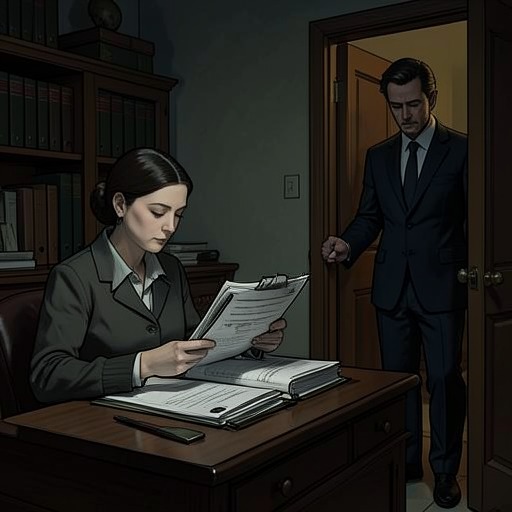
Chigwell Residence
Blood ShotChigwell Residence is both Florence Chigwell’s childhood home and the setting where a family’s private rooms become entangled with the medical records of Xerxes employees. Its carefully ordered books, silver, and domestic routines contrast with the evidence of conflict within it: Curtis Chigwell tried to burn his notebooks, Florence hid them, and someone later entered the house and took his copies. When V. I. Warshawski visits, the house is not merely a backdrop to the investigation. Its rooms and concealed records make the struggle over what can be known, preserved, or destroyed tangible.
Setting and Domestic Order
The residence is introduced through Florence’s welcome to Warshawski after Warshawski has made the journey to see her. Florence’s manner is fierce and unsmiling, but Warshawski recognizes that the roughness is not meant as unfriendliness. Inside, a fire burns in the grate, and a silver tea service catches its colors on a low table. Florence offers tea, describing it as her one daily stimulant and joking that her brother regards such reliance as weakness. The exchange gives the house a distinct domestic rhythm even as the reason for the visit points toward trouble.
The rooms reinforce an image of order maintained through attention and habit. Books line the upper landing, where around a thousand volumes are neatly dusted and aligned. Florence’s sitting room contains a rocking chair, knitting basket, and old Remington typewriter; there, bookshelves built only to waist height also serve as platforms for flowering plants. The combination of reading, work, and flowers makes the room both practical and personal. The house’s objects are not anonymous furnishings: they are arranged around the interests and routines of the person who lives there.
That order has limits. Florence tells Warshawski that she tidied the books and silver after the disturbance, but had not vacuumed or dusted. The investigator’s painstaking search nevertheless turns up dried mud on the stair carpeting, a trace that may indicate an intruder but does not establish how that person entered. None of the locks shows signs of being forced. The contrast is telling: the house’s familiar arrangement has been restored in part, yet the mud remains as a small, material disruption that resists the appearance of complete domestic control.
Curtis’s Study and the Missing Notebooks
The investigation leads upstairs to Curtis’s study. Florence explains that on Monday evening she smelled fire and found Curtis trying to burn his notebooks in a leather wastebasket. The basket itself began to burn and left a mark where it burned through to the carpet. In the house, an attempt to destroy records therefore becomes a physical episode, not a secret that can be made to disappear without residue. Florence took the notebooks and hid them behind her boating books, believing Curtis should not evade the facts by destroying them. She later recognizes the hiding place as an obvious one because boating was her own great love and a likely place for Curtis to search.
The missing materials are Curtis’s copies, not the only surviving record. Florence had typed his notes over the years and kept the original notebooks without telling him. She also gives Warshawski twelve green, leather-bound diaries belonging to their father, Horace Chigwell, M.D. They cover twenty-eight years; the medical histories within them appear to document Xerxes employees. Curtis had coveted these diaries, and Florence disliked his using their father’s personal records, but she had seen no sufficient reason to refuse him access. Their presence in the house links its family history to the industrial history under investigation, while Florence’s preservation of the originals means that a break-in has not erased the evidence entirely.
Break-In and Investigation
Florence contacts Warshawski because she believes Curtis broke into the house that afternoon. Curtis lives there, but after Florence took him to the hospital on Tuesday, he was released the following day and said he would stay with friends rather than face her at breakfast. Florence admits that she was also glad to have a few days without him. His absence makes the suspected entry harder to interpret: she considers that Curtis may have come himself, or may have let in someone unfamiliar with the house, someone who would have caused a disturbance.
She initially reports that nothing valuable is missing, then identifies the medical notebooks as the loss that matters. Her concern is not simply that papers have been taken. She believes the notes may explain what Curtis was involved in at the Xerxes plant and what he had not wanted to tell Warshawski. Warshawski searches the house, finding the mud but no forced locks, and concludes that Florence may be at risk if whoever entered returns. The residence thus becomes a site where ordinary clues carry uncertainty: the missing copies matter, the originals remain, and the physical evidence points toward an intrusion without resolving its perpetrator or means.
The House as a Place of Resistance
Warshawski advises Florence not to spend the night alone, reasoning that an intruder who has already entered could return, possibly to demand an explanation for Warshawski’s visit. Florence refuses to leave. She grew up in the house and insists that no one will force her from it. Her decision leaves the investigator uncertain whether Florence is concealing fear or understands more about Curtis’s desperation than she has said. Yet Florence’s decision to give Warshawski the original diaries weighs against the idea that she is simply withholding them to protect her brother.
The house’s significance rests in this unresolved balance between shelter and exposure. It holds family possessions, a lifetime of books, and records that may illuminate harm at the Xerxes plant; at the same time, its domestic privacy has been penetrated, and its owner will not surrender the home in response. The carefully kept interior does not make the danger orderly or legible. Instead, the study, the hiding place behind the boating books, the singed carpet, and the mud on the stairs give the investigation a material history: attempts to destroy or seize the records leave traces, while Florence’s insistence on remaining makes the residence a place of personal resistance as well as a repository of evidence.